design + energy + excellence

Author: aoife (Page 12 of 28)

Wexford County Council Headquarters

The new 11,500 sq.m. Wexford County Council Headquarters have been completed and all departments have been relocated.

The project was won in an international competition organised by the RIAI in 2006 and is the first building to complete since Lee’s practice Nord LLP was renamed Robin Lee Architecture in April 2011.

The building sits on a sloping site on the outer fringes of Wexford town, in South East Ireland, with fine views to the River Slaney Estuary and the Blackstairs Mountains. It brings together the services and departments of Wexford County Council that, until now, have been housed separately within the centre of the town.
Wexford County Council new headquarters

Photo by Andrew Lee.

An outer layer of glass wraps around the blocks and acts as the outer skin of a double façade. This provides protection on an exposed site but also regulates the interior temperature through the control of air around the building; cooling the building in the summer and creating an insulating layer during the winter. See more photos here.

Wexford County Council new headquarters

Photo by Andrew Lee

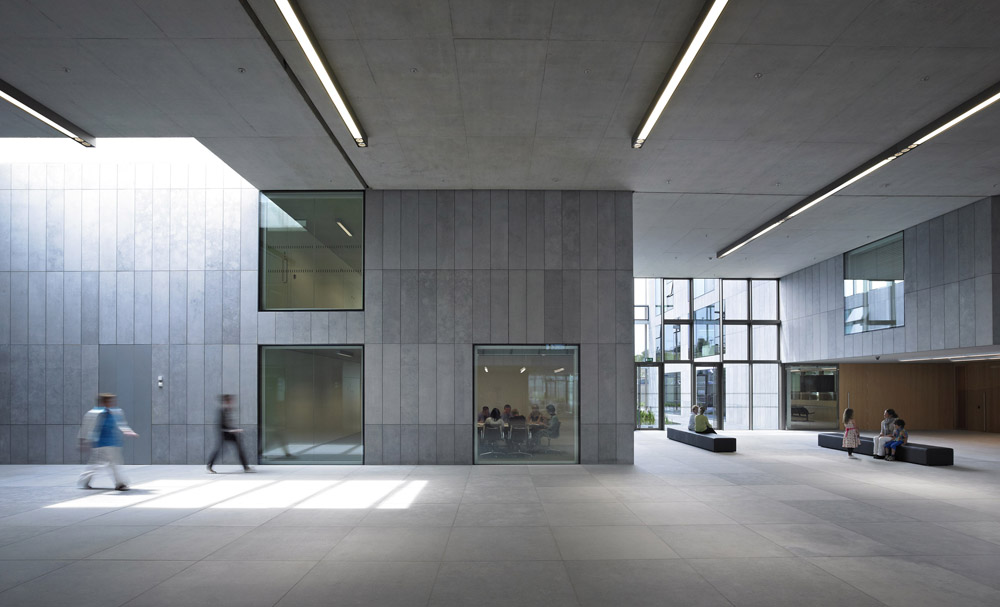
Internally walls and floors are clad in Irish Blue Limestone, a material which is synonymous with the rich history of civic buildings in Ireland, creating a sculpted interior volume with a calm, refined atmosphere.

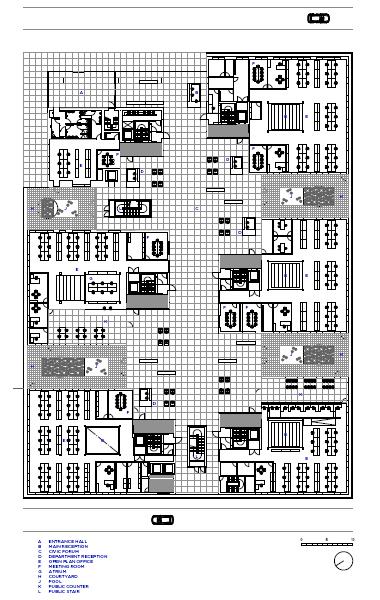
New Headquarters for Wexford County Council – Ground Floor Plan

The accommodation is laid out as a series of six discrete blocks; each block houses key services and individual departments. The blocks are gathered around a large central space, a ‘civic forum’, which gives access to all of the council facilities.


Materials:
– An outer skin of low iron glass structurally bonded to umber anodized aluminium framing
– Walls are clad internally and externally in 1.8m high slabs of Irish Blue Limestone on stone hanging system
– Public area floors are 1.2m square slabs of Irish Blue Limestone with underfloor heating
– Internal floors are Junkers European Oak
– Punched windows are Ipasol performance glass
– Vents are Silberstar semi-reflective performance glass
– Internal joinery work is European Oak – solid timber and veneered boards
– External terraces are limestone gravel and Irish Blue Limestone walls
– Hard landscaping is bespoke concrete paving with natural aggregates
– External timberwork is Siberian Larch

Sustainable features:
– Double façade for energy efficiency and environmental control
– Floor plates optimised for natural ventilation and natural lighting
– Exposed concrete slabs for thermal mass
– BMS for overall building control and energy efficiency
– Biomass boiler
– Evacuated solar tubes for water heating
– Grey water recycling
– Locally sourced materials including Irish Blue Limestone

Read previous posts here.

See more photos here and here.


Do I Need a Contract for My Project?

On further investigation, the question divides into two parts:

  1. Am I required by law to have a contract?
  2. If not, should I have a contract anyway – or as it’s sometimes expressed: ‘can I get away without one’?

Am I required by law?

I should perhaps start by saying I always find it a little strange that anyone contemplating having expensive construction work carried out should even consider the possibility of not wanting to know precisely what the terms and conditions are. It is always a source of puzzlement that parties to jobs with a value of millions should apparently find the cost of less than £50 for some formal contract documentation to be prohibitive.

There is no overarching ‘legislative’ requirement, in the sense that a general law exists requiring all parties to have a specific type of agreement.

Should I have a contract?

The simple answer is an emphatic ‘yes’. But the truth is that you probably do anyway.

Let us look at what a contract represents. A contract typically will result when one party agrees to do something for another in return for ‘consideration’ – usually expressed in monetary form. Essentially it is simply a set of ‘conditional’ promises: “If Party A does this, then Party B will do that” and so on. The terms of that contract may be many and varied, however. They will reflect the complexity of what is being done, and the method used.

It doesn’t have to be written down, but it certainly helps if it is. If the agreement is verbal, then how do you remember what they were, but even if it’s in writing, are the words free of ambiguity, or could they be interpreted differently by someone else?

If a project ends in dispute, this is one of the first problems the person tasked with sorting it out has to resolve. If you have no record of what’s been agreed, how can you know what to do if something goes wrong?

Summary

If you buy a TV, car, garden shed, or even an existing house, you can usually go and see it and look around before deciding whether to proceed. If, however, you are buying a new building, the chances are you are buying into a concept: a design idea which has yet to be realised. To many Clients, this is a leap of faith; building is not their core business, so they may not have the technical capability to visualise what is being described to them, despite advances in computer models and 3D software.

For the uninitiated, or even the experts, this can be a difficult task. Having a contract and knowing what the terms are at least brings some certainty. So why anyone would want to attempt it without one is a mystery.


Read more Contracts are for wimps: why would I need a (standard) building contract?

by Roland Finch
NBS Technical Author

via NBS 


Isabel’s Picks for July 2011

Isabel’s Picks for July 2011

GOING ROUND AND ROUND

Circles and curvy detours


1. CEILING LIGHTS

Manufacturer: TAL

Name: Symbiosis Zoox

Price Range: n/a

Material: Opal polycarbonate.

Lamps: TC-L 18W

Available in Ireland from: Wink


2. ACOUSTICAL CANOPY

Manufacturer: Armstrong

Product name: Optima Canopy

Price Range: n/a

Material: Mineral.

Key Facts: Help reduce noise levels by 50%. Lights and speakers cab be integrated into the panels.

Available in Ireland from: CPD/SIG


3. TABLE

Designer: Reestore

Name: Silvana Washing Machine Table

Price Range: €350

Materials: Made from a reclaimed washing machine drum, with an internal low energy light for unique ambient lighting. A frosted glass surface completes the Silvana table.

Available to Ireland from: EcoCentric


4. BIKE STORAGE

Product name: Cycloc

Price Range: €80

Material: The Black Cycloc is made from 100% recycled plastics. The coloured ones are made of durable virgin plastics. Available in White, Orange, Green and Black.

Key Facts: The Cycloc provides handy, and trendy, bike storage, and can be mounted to hold your bike horizontally or vertically. Cycloc is also lockable, meaning you can use it indoors or outdoors.

Available in Ireland from: Designist


5. PHOTO MURAL

Manufacturer: Mr. Perswall

Name: Signpole mural

Collection: Destinations

Price Range: €95

Available to Ireland from: Wallpaperdirect

____________________________________________________________________________

See More Picks


« Older posts Newer posts »