design + energy + excellence

Author: barros (Page 56 of 61)

Guided Factory Tour at Fronius in Austria

Fronius creates new technologies and solutions for monitoring and controlling energy. They are technological leaders in the field of battery charging systems, welding technology and solar electronics.

This tour was part of the Renewable Energy Research Trip to Austria that took place in November 2011.

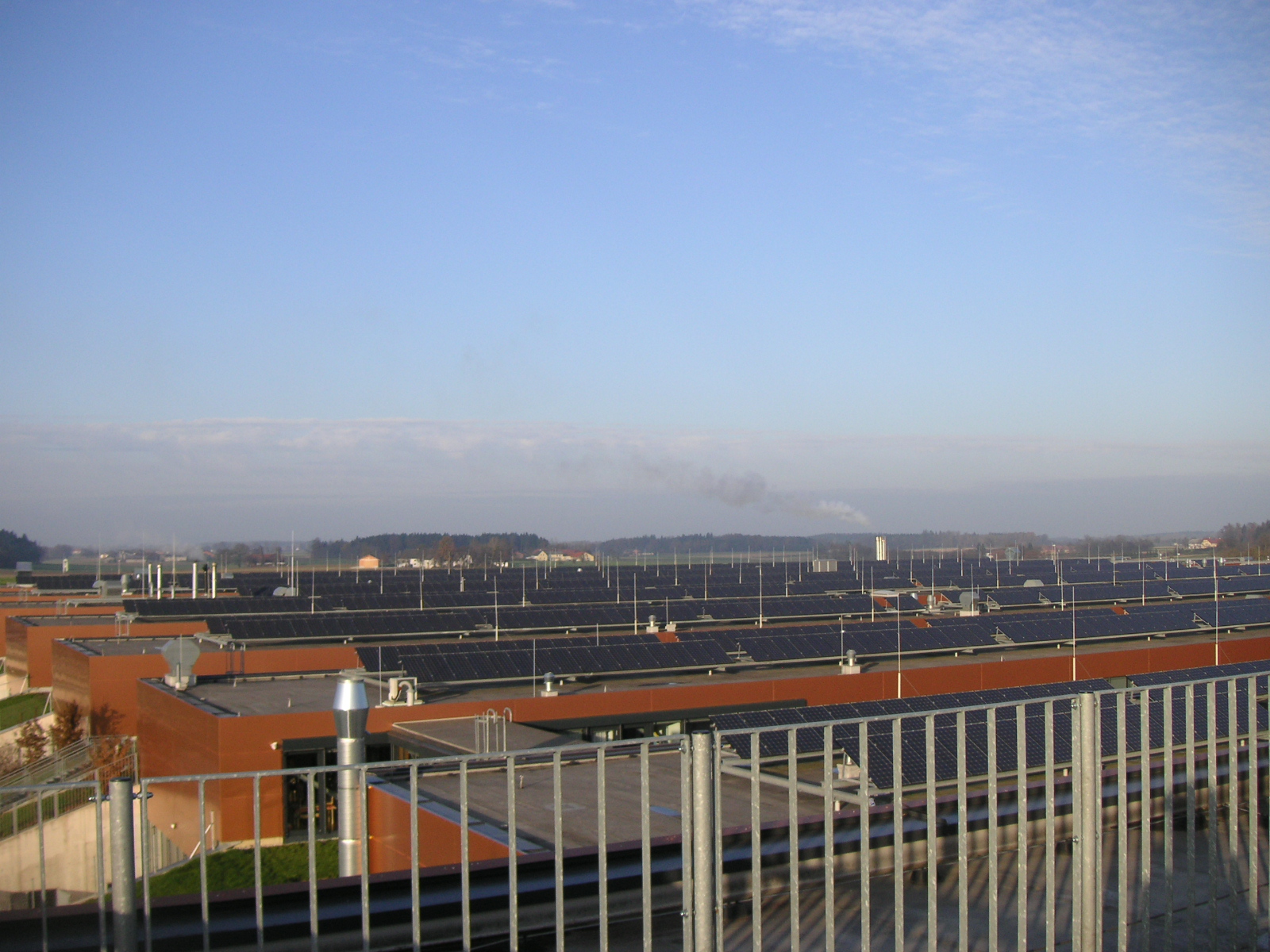
The factory is impressive but unfortunately we weren’t allowed to take photos inside. The 38,000 sq.m. building features an innovative energy concept with one of the largest photovoltaic systems in Austria (615 Kwp/3600 sq.m.), a biomass power station (1500kw) and a geothermal system for heating and cooling.
Fronius Austria Factory Solar PV

Fronius Factory – Roof with solar photovoltaics

[pinterest]

Just the photovoltaic system on its own could cover the annual electricity consumption of 160 households.


Fronius Austria Factory Creche

View to the Fronius “Kinderland” creche

[pinterest]

Added extras, such as the Fronius “Kinderland” creche and staff restaurant, cater for the wellbeing of employees.


I was also very impressed with their HyLOG project.

“HyLOG” stands for Hydrogen powered Logistic System. The ambitious goal of this project is the implementation of an emissions-free and more efficient in-house logistics system in a real industrial application environment – in this case, at the Fronius facility in Sattled, Austria.

Fronius Austria Hydrogen Energy HyLog Project

Fronius HyLog Project

[pinterest]

Instead of batteries, logistical vehicles at the Fronius Sattledt location are operated using environmentally-friendly hydrogen.

The hydrogen used for the HyLOG vehicle is produced by Fronius in-house via an electrolysis process powered by the 615 kW PV system on the roof of the building. The hydrogen is then stored and made available for refueling via an in-house filling station infrastructure. The fuel cell drive integrated into the vehicle is used to convert the hydrogen into energy to operate the vehicle.


1. PV modules. 2. Electrolyser. 3. Hydrogen reservoir. 4. Hydrogen tank. 5. Fuel cell (on-board). 6. Electronic drive unit (on-board). 7. Inverter. 8. Sattledt production facility. 9. HyLOG truck.

[pinterest]

Here’s how it works: The PV modules (1) capture the sunlight and turn it into DC current. Power needed immediately at the Sattledt production facility (8) is made available by way of the electronic inverter module (7). The rest of the electric power is used by the electrolyser (2) to split water into its twin constituents, oxygen and hydrogen. The hydrogen is stored in a reservoir (3), and the oxygen is released into the atmosphere. The HyLOG vehicles are refuelled with this stored hydrogen at a filling station (4). Together, the fuel cell (5) and electronic drive unit (6) integrated in the HyLOG truck (9) turn the hydrogen into motive power. The main benefit of this zero-emission materials-handling solution is that refuelling with hydrogen only takes a few minutes, whereas conventional battery-powered warehouse trucks have to be recharged for 8 to 10 hours every time.


Isabel Barros

Isabel’s Picks for April 2012

4 LITTLE BIRDS PITCH BY OUR DOORSTEP

It’s Spring, it’s Easter and we love it!

IKEA, Solar wind-powered pendant lamp, Corque Design, Cork, Portugal, Cork seat, Vinco, 3form facet, space divider, Styley walls, turquoise wall paper


[pinterest]

1. SOLAR/WIND POWERED PENDANT LAMP

Manufacturer: Ikea

Designer: David Wahl

Product Name: Solvinden

Price Range: €30.49

Key Features: No costs for electricity; the solar panel and the wind power generator convert sunlight and wind to energy. Easy to use; no cables or plugs are needed. Creates interesting light effects when it rotates in the wind. Built-in LED light source.

Available in Ireland from: Ikea


2. WALL DECAL

Product Name:Blossoming Almond Branch – Gift Birds

Price Range: €45

Material: High quality, self-adhesive and waterproof vinyl.

Key Facts: Easy to install and removable but may not be repositioned or reused once applied to your wall or surface.

Available to Ireland from: Etsy


3. PARTITION SYSTEM

Trademark: 3form

Designer: Bloomming

Product Name: Facet

Price Range: n/a

Material: Eco-resin 3D shapes, aluminium frame and stainless steel attachment elements.

Key Features: Completely modular system with endless possibilities. Easy to install with only 5 components. Light weight. Infinite and interactive. Sustainable. UV resistant and antistatic. Each Facet can be rotated 360 degrees individually or in sets to create different patterns and transparency. Innovative space dividing and window screen system with a unique sculptural design that allows you to play with interior space, shade and light with interactive elements.

Available to Ireland from: 3form


4. CHAIR

Trademark: Corque

Designer: Toni Grilo

Product Name: Vinco

Price Range: n/a

Material: Natural agglomerate cork, rubber cork and polished steel.

Key Features: “Vinco” chair offers a sophisticated feel with natural touch, providing a unique sensorial experience with cork. “Vinco” aesthetical beauty derives from the original shape created by a set of “creases” in a cork flat board. The creases in “Vinco” form a volumetric structure out of a flat one aiming economy production. Reinforcing this concept the board assembles the polished steel structure by fitting, without any glue or screws.

Available to Ireland from: Corque


____________________________________________________________________________

See More Picks

Visit to Power Tower Energy AG in Austria

The Power Tower in Linz, Austria is the first office tower to attempt to meet the Passive House standards.

This visit was part of the Renewable Energy Research Trip to Austria that took place in November 2011.

The Power Tower was built to house the corporate headquarters of the Austrian utility company Energie AG. The new offices were built from 2006 to 2008 on the same location of Energy AG previous headquarters built in the 1930s. We were told that when they demolished the original building everything that was possible to reuse it was kept and used in the new building.


Energy Systems

The Power Tower is not dependent of fossil fuels. The energy is obtained through the soil and the ground water, and/or generated by the solar panels that are integrated into the façade.

Façade

Dieter Moor from Ertex Solar was our guide for this visit. He explained the façade was specifically developed for this project and 90% of the solar heat remains outside the building, therefore it was not necessary to install a conventional air-conditioning system. The building envelope was specially engineered to allow maximum day lighting while minimizing solar gain, which would normally be excessive and require a great deal of active cooling.


The façade system is made of enclosed panels (with no access), quadruple glazed, and the outside pane has two glass panels laminated together. A small device inside each module sucks the air and moisture. The U-Value is 0.5 W/m².

60% of the Power Tower façade is transparent, the remaining 40% have an opaque surface highly insulated.


The South façade has three vertical photovoltaic bands that cover approximately 650m² and generate about 42,000 kWh of electricity per year (10% of the building’s energy).


Heating and Cooling

A combined heat-pump plant provides 100% of the energy to the heating, cooling and ventilation systems of the high-rise office building.

Power Tower - Plant Room

Power Tower - Plant Room


The soil and the ground water are used as thermal sources. Depth probes and foundation piles extract the energy for heating and cooling from the ground.


Power Tower - Manifold for the 46 geothermal wells


Beneath the building, 46 geothermal wells, each 150 m deep were drilled prior to construction (this is nearly 7 km of boreholes!).

As a special feature the heat accumulated during cooling operations in the summer is pumped back into the soil and can be used for heating in the winter.


Ventilation

Heating and cooling panels with radiation effect are suspended from the ceiling. A controlled ventilation system supplies fresh air, as the windows of the building cannot be opened.


Lighting

A total of almost 700 LED lighting elements were installed, which create extraordinary light effects. This artistic light installation uses a maximum of 1.4 kW, which is less electricity than is consumed by a commercial vacuum cleaner.


Power Tower - Internal Courtyard


Fact sheet

Gross floor space: 32,872 m² (incl. underground garage)

Façade surface: 11,620 m² (of this photovoltaic surface 637 m²)

Height of tower: 73 m

Number of floors in tower: 19

Number of floors in underground garage: 2

Number of garage parking spaces: 246

Maximum heating output: 700 kW

Maximum cooling output: 800 kW

Construction costs: €42 million euro (excludes sustainable energy grants)


Isabel Barros

 

« Older posts Newer posts »