design + energy + excellence

Tag: costs (Page 4 of 6)

Building Costs in Ireland 2014

Every year we share useful information to guide you on the costs for your construction project in Ireland. This will help you to estimate an approximate figure for your building costs.

You can check our other articles in this series here.

The Irish construction industry is slowly recovering. Predictions mention an 8% increase in value of output during 2014.

The Society of Chartered Surveyors Ireland  reported that Tender Prices have bottomed out and have begun to increase due to a rise in input costs and commodity prices (oil etc). SCSI also reported that Construction tender prices grew by 2.2% in the second half of 2013, up from 0.9% in the first half of the year. The annual increase for 2013 was 3.1% and there is an increasing awareness amongst contractors and sub-contractors of the true cost of carrying out work and a reluctance to price below this, which ensures that projects are priced at viable levels.


Average Irish Construction Prices 2014

The average construction costs table is generated using Bruce Shaw’s Cost Database and sets out typical building construction costs.

(Click image to enlarge)

Bruce Shaw average construction prices_2014


The building costs of 2013 are still a good starting point for your project.

Turner & Townsend‘s annual construction cost survey provides a comprehensive and detailed overview of construction costs in Ireland, in 2013.

(Click image to enlarge)
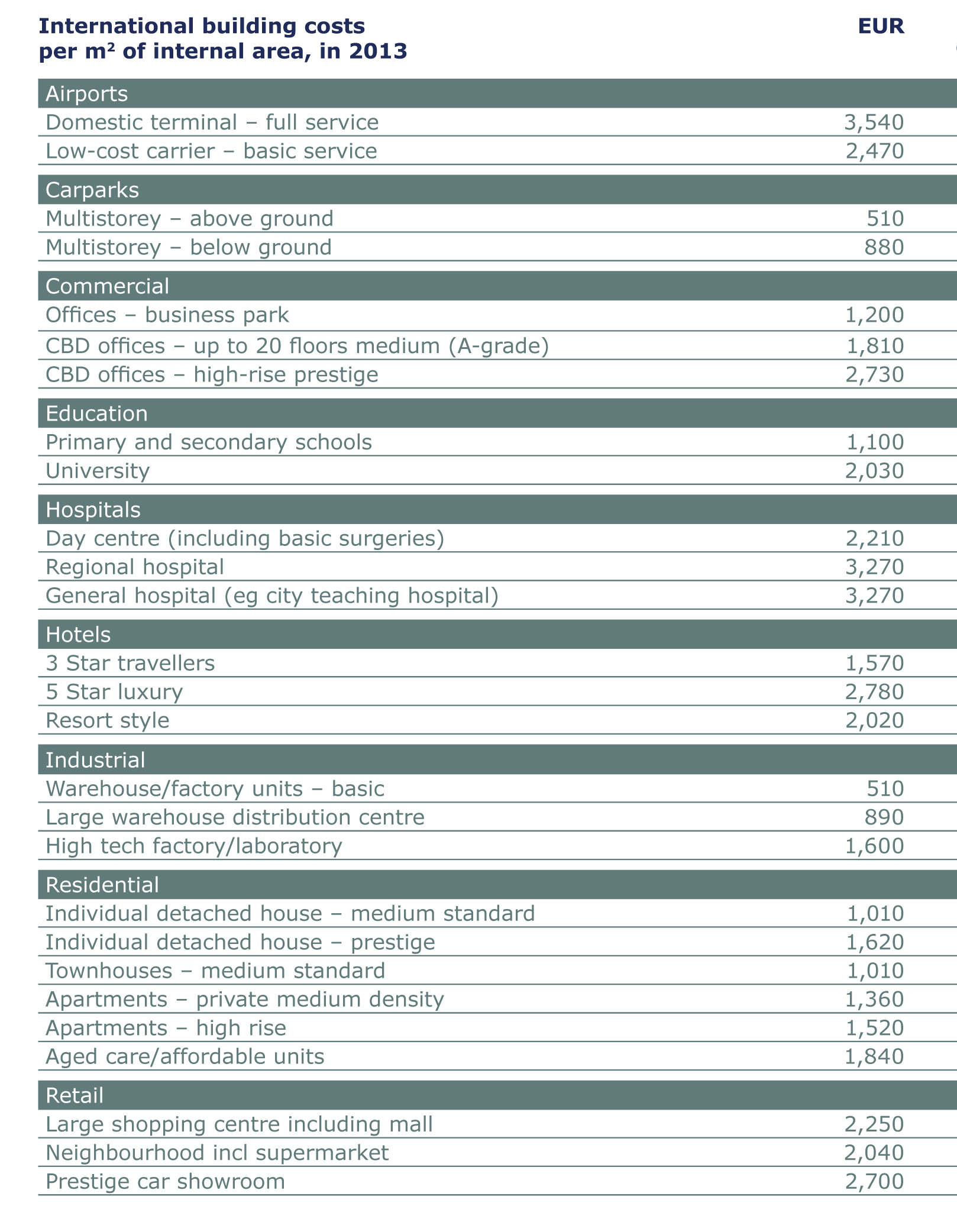
Turner and townsend_Ireland_construction_cost_survey_2013_Price sqm


Labour rates and Construction Materials Prices

Turner & Townsend‘s annual construction cost survey provides labour costs and also the prices for some materials. Note the cost escalation forecast of 2%.

(Click image to enlarge)

Turner and townsend_Ireland_building_cost_survey_2013_Labour Material Etc

In June 2014 CSO recorded that all building and construction materials prices increased by 1.3% in the year since June 2013.

The most notable yearly changes were increases in Sand and gravel (+33.6%), Hardwood (+14.5%) and Stone (+5.7%), while there were decreases in Fabricated metal (-3.4%), Other Structural steel (-1.8%) and Reinforcing metal (-1.5%).


Guide to Rebuilding Costs in Ireland

The Society of Chartered Surveyors publishes every year a guide to rebuilding costs in Ireland. This guide is intended to assist in insuring a house and the costs included are based on building rates as of March 2014.

(Click image to enlarge)
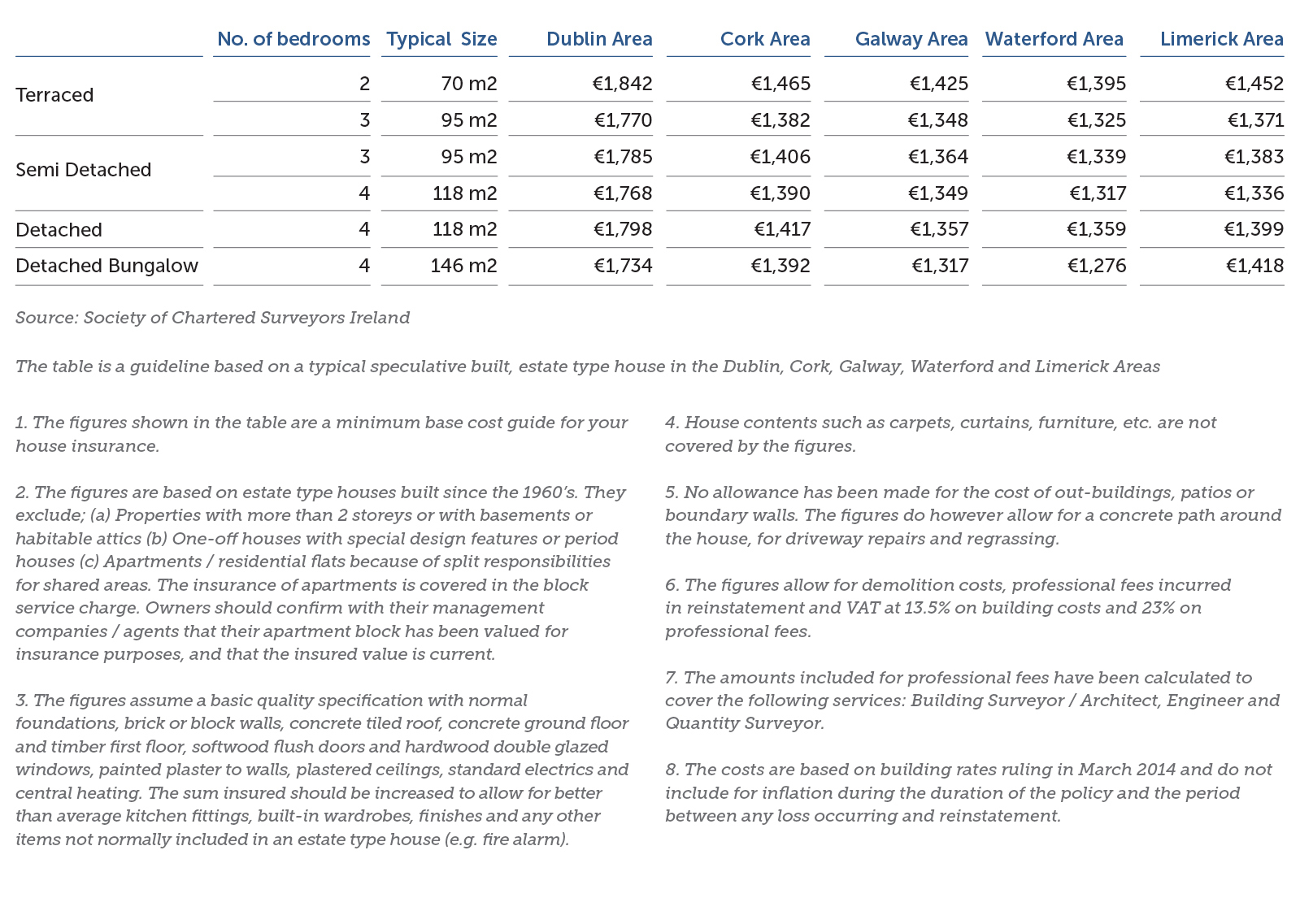
SCSI House Rebuilding Costs per sqm_2014

SCSI also provides a House Rebuilding Cost Calculator here, and a Home Renovation Incentive Scheme Calculator here. You can read more about this Incentive Scheme here.


Other Resources

Paul McNally Ecological Architecture in Cork has developed a very detailed and user friendly cost estimator for new build houses. Grab all the information you can and get your estimate here.
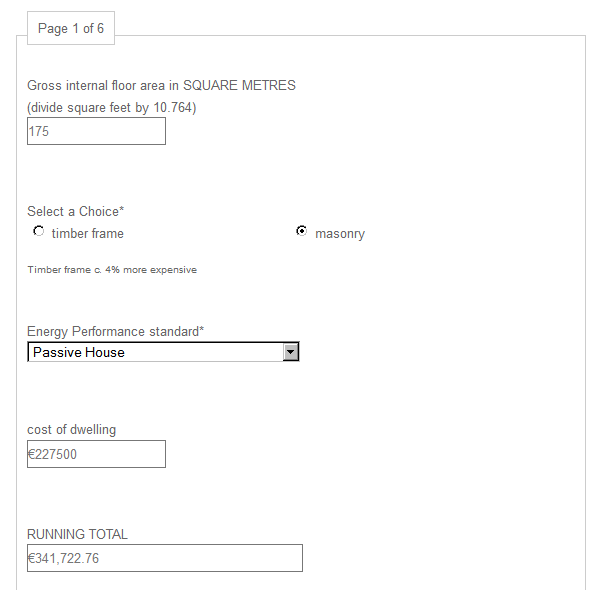
New_Build_House_Budget_estimator_Paul_McNally_Ecological_Architecture_MRIAI_-_2014-07-29_22.11.43


Typical Exclusions

There are a number of other expenses that you should also consider when estimating your project. See some of the exclusions that may apply to your project here.

Additionally, with the newly amended Building Control Regulations, you are also likely to need to allow for:

  • Assigned Certifier fees


Check out our other articles in this series



Home Renovation Incentive Scheme

The Home Renovation Tax Incentive (HRI) scheme was announced in the Budget 2014  and will run from 25 October 2013 to 31 December 2015.

This incentive provides a tax relief by way of an income tax credit at 13.5% of qualifying expenditure on:

• repair

• renovation or

• improvement works.

This includes extensions, garages and attic conversions; the supply and fitting of kitchens, bathrooms and built-in wardrobes; fitting of windows; plumbing, tiling, rewiring and plastering.

To qualify for the HRI, you must be an owner-occupier and the work must be carried out on your principal private residence.

Any contractor you use must be registered for Value Added Tax (VAT) in Ireland and be tax-compliant. If several contractors, such as a builder, a plumber and an electrician, carry out qualifying work on your home, you can combine the cost of the works to make up the minimum qualifying amount.

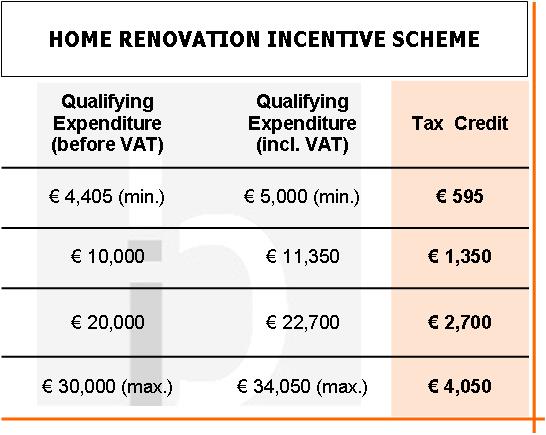
Have a look at the table below to see some examples of the tax credit you can get.

HRI TableThe works must cost a minimum of €4,405 (before VAT), which will attract a credit of €595. Where the cost of the works exceeds €30,000 (before VAT), a maximum credit of €4,050 will apply.


 

Example 1

luxury-bathrooms.1153.featured

You hired a builder to carry out a bathroom renovation for €10,000 (before VAT at 13.5%). The work was carried out and paid for in April 2014. Your builder entered the details to the electronic HRI system.

You hired a painter to carry out internal and external painting for €2,000 (before VAT at 13.5%). The work was carried out and paid for in September 2014. Your painter entered the details to the electronic HRI system.

You claim your tax credit in January 2015. Your tax credit is €12,000 x 13.5% = €1,620. You receive your tax credit of €810 in 2015 and €810 in 2016.


Example 2

You paid €7,048 plus VAT (at 13.5%) of €952 = €8,000 for repair works and an insurance payment of €6,000 was received in respect of the repair works.

The qualifying expenditure of €8,000 will be reduced by €6,000.

Leaving €2,000 (€8,000 less €6,000) qualifying expenditure.

This €2,000 includes VAT of €238.

The tax credit can be claimed on the €2,000 less €238 = €1,762 (before VAT).


Example 3

€8,810 plus VAT (at 13.5%) of €1,190 = €10,000 was paid for external wall insulation.

€2,700 was received under the Better Energy Home scheme grant.

The €10,000 will be reduced by €8,100 (€2,700 x 3) leaving €1,900 (€10,000 less €8,100) qualifying expenditure.

This €1,900 includes VAT of €226.

The tax credit can be claimed on the €1,900 less €226 = €1,674 (before VAT).


Example 4

 Electrician

You paid €5,000 (before VAT) to a VAT registered and tax compliant electrician for rewiring your home, your tax credit is €5,000 x 13.5% = €675.


Example 5

You paid a VAT registered and tax compliant builder €40,000 (before VAT) for an extension on their home

The tax credit is €30,000 x 13.5% = €4,050.


Examples of repair, renovation or improvement works that qualify under the Incentive:

  • Painting and decorating
  • Rewiring
  • Tiling
  • Supply and fitting of kitchens
  • Extensions
  • Garages
  • Landscaping
  • Supply and fitting of solar panels
  • Conservatories
  • Plastering
  • Plumbing
  • Bathroom upgrades
  • Supply and fitting of windows
  • Attic conversions
  • Driveways
  • Septic tank repair or replacement
  • Central heating system repair or upgrade
  • Supply and fitting of built in wardrobes

The VAT rate on works carried out must be 13.5%.

Please note the above is not a complete list.


What type of home qualifies?

A qualifying home is:

  • A Homeowners main home, which the Homeowner must own and live in or
  • A second hand home, which the Homeowner has bought and will live in as the Homeowner’s main home after the works have been carried out. (A complete reconstruction of an uninhabitable house does not qualify).


Please check the Revenue website for more information.

Construction Costs in Ireland 2013

Click here for our most recent post about Construction Costs in Ireland (2014).

Calculating the construction costs for your project is not an easy task. Every year we publish some guidelines and average prices to help you getting an approximate figure.

Our posts about Construction Costs are very popular and provide useful information to guide you on the costs for your construction project in Ireland.

We have seen an increase in tender prices since contractors have realised that below cost tendering is not sustainable.

Although the reduction in construction prices has been reversed there is still very good value to be had, says Bruce Shaw’s latest report.

The newly amended Building Control Regulations will come into effect on March 2014. While these changes aim to protect the consumer lets not forget that the additional requirements imposed by them will also increase the overall construction costs.


Average Irish Construction Prices 2013

The average construction costs table is generated using Bruce Shaw’s Cost Database and sets out typical building construction costs.

(Click image to enlarge)

Bruce Shaw Average Irish Construction Costs 2013


Labour Rates

Labour rates were reduced by 7.5% in February 2011. We could not find updated data in relation to 2013 rates but the lack of skilled workmanship may turn this trend around.


Construction Materials Prices

In May 2013 the CSO recorded that all building and construction materials prices increased by 1.1% in the year since May 2012. This is 1.9% less than what was recorded during the same period last year.

The most notable yearly changes were increases in Glass (+10.4%), PVC pipes and fittings (+9.9%) and Stone (+4.7%) while there were decreases in Paints, oils and varnishes (-5.8%), Other Structural steel (-3.8%) and Hardwood (-3.8%).


Guide to Rebuilding Costs in Ireland

The Society of Chartered Surveyors publishes every year a guide to rebuilding costs in Ireland. This guide is intended to assist in insuring a house and the costs included are based on building rates as of March 2013. Click here to read the full publication.

(Click image to enlarge)

SCSI House Rebuilding Costs per sqm 2013


The Society of Chartered Surveyors website provides a handy House Rebuilding Calculator. This calculator can be used as a guide to give you a minimum base cost for your construction project.


Typical Exclusions

The above Irish Construction Costs should be used only as guidelines. There are a number of exclusions that you should also consider, and there is one that you cannot even calculate – risk.

Some of these exclusions will apply to your project others will not. But typically they will be:

  • Land Acquisition costs
  • Legal fees
  • Site investigation and surveys
  • Archaeology survey / excavations
  • Planning fees and charges
  • Architect fees
  • Structural Engineer fees
  • Quantity Surveyor fees
  • Energy Consultant fees
  • PSDP & PSCS fees
  • Financial contributions (Local Authority Contributions)
  • Utility suppliers fees & charges
  • BER Certs
  • Air Tightness Specialist
  • Inflation
  • VAT
  • Contingency
  • Loose furniture, fittings and equipment
  • Financing costs
  • Fire certificate fees


Check out our other articles in this series.

« Older posts Newer posts »