design + energy + excellence

Tag: Prizes (Page 2 of 4)

Chilean Architect Alejandro Aravena Receives the 2016 Pritzker Architecture Prize


“Our plan is not to have a plan, face the uncertain, be open to the unexpected.” – Alejandro Aravena.


Alejandro Aravena, a 48-year-old architect based in Santiago, Chile is the 2016 Pritzker Architecture Prize Laureate.


Aravena has won some of the most prestigious architecture prizes in the world. This time he takes home the prestigious Pritzker Prize.

Alejandro Aravena, the 2016 Pritzker Architecture Prize Laureate

Alejandro Aravena, the 2016 Pritzker Architecture Prize Laureate


Since 2001, Aravena has been executive director of the Santiago-based ELEMENTAL, a “Do Tank,” as opposed to a think tank, whose partners are Gonzalo Arteaga, Juan Cerda, Victor Oddó, and Diego Torres.

Quinta Monroy Housing, 2004, Iquique, Chile

Quinta Monroy Housing, 2004, Iquique, Chile


ELEMENTAL has designed more than 2,500 units of low-cost social housing. Aravena’s social housing projects combine innovative architectural design with a social framework that encourages personal investment on the part of the inhabitants. It is a design that leaves space for the residents to complete their houses themselves and thus raise themselves up to a middle-class standard of living.

Monterrey Housing, 2010, Monterrey, Mexico

Monterrey Housing, 2010, Monterrey, Mexico


Aravena didn’t always have this faith. Shortly after graduating in the early 1990s, following a succession of “shitty clients … restaurants, bars, shops”, he got so disillusioned that he quit architecture and opened a bar. “I lived by night, waking up at 5pm and going to bed at 10am,” he says. When he eventually decided to resume his career, he got lucky. A sculptor asked him to design her house, and this was when he learned the lesson that perhaps makes him so intolerant of what’s on offer at the biennale. “I wanted to have that kind of freedom,” he recalls, “so I said, ‘Don’t pay me, but allow me to do whatever I want.’ I think I was rigorous enough, but it was still a completely stupid thing.”


Sculpor's House, Santiago, Chile

Sculpor’s House, Santiago, Chile


“He understands materials and construction, but also the importance of poetry and the power of architecture to communicate on many levels.”, 2016 Pritzker Architecture Prize Jury.

Siamese Towers, 2005, San Joaquín Campus, Universidad Católica de Chile, Santiago, Chile

Siamese Towers, 2005, San Joaquín Campus, Universidad Católica de Chile, Santiago, Chile


The 2016 Pritzker Architecture Prize Jury Citation states in part, “Alejandro Aravena has delivered works of architectural excellence in the fields of private, public and educational commissions both in his home country and abroad…. He has undertaken projects of different scales from single-family houses to large institutional buildings….

Writer’s Cabin, 2015, Jan Michalski Foundation, Montricher, Switzerland

Writer’s Cabin, 2015, Jan Michalski Foundation, Montricher, Switzerland


The thinking behind the ELEMENTAL project to improve social housing is based in 2 principles:

  1. For poor people, location is even more important than is usually the case.  The key question is – “Where is social housing located.”
  2. A house should gain in value.  Social housing should be an investment, not a social expense.
Villa Verde Housing, 2013, Constitución, Chile

Villa Verde Housing, 2013, Constitución, Chile


Aravena’s work reminds us that architecture is not just a cultural act but a social one.

You can watch Aravena’s TED talk – My architectural philosophy? Bring the community into the process – here:


Japanese Architect Shigeru Ban Becomes 2014 Pritzker Laureate


Shigeru Ban, a Tokyo-born, 56-year-old architect is the 2014 Pritzker Architecture Prize Laureate.

Reached at his Paris office, Shigeru Ban said, “Receiving this prize is a great honor, and with it, I must be careful. I must continue to listen to the people I work for, in my private residential commissions and in my disaster relief work. I see this prize as encouragement for me to keep doing what I am doing — not to change what I am doing, but to grow.“


Shigeru

Shigeru Ban, the 2014 Pritzker Architecture Prize Laureate

Shigeru started his practice without any working experience right after he graduated from Cooper Union (New York). He is well known for making monumentality out of cardboard.

Shigeru has used cardboard tubes to build a number of structures. He hates to thrown things away, and in 1985 when he was left with lots of cardboard tubes from an exhibition he designed for Emilio Ambasz, he decided to re-use them for an exhibition for Alvar Aalto. This was the first time he began experimenting with spatial applications for cardboard tubes.

Ban's Alvar Aalto Exhibition (1986) in Tokyo, where he first began experimenting with spatial applications for cardboard tubes.

Alvar Aalto Exhibition,1986, Tokyo

[pinterest]

Ban’s humanitarian work began in response to the 1994 conflict in Rwanda, which threw millions of people into tragic living conditions. Ban proposed paper-tube shelters to the United Nations High Commissioner for Refugees and they hired him as a consultant.

Paper Log House, 1995, Kobe, Japan

Paper Log House, 1995, Kobe, Japan

[pinterest]

Shigeru Ban reflects the spirit of the prize to the fullest. He is an outstanding architect who, for twenty years, has been responding with creativity and high quality design to extreme situations caused by devastating natural disasters. His buildings provide shelter, community centers, and spiritual places for those who have suffered tremendous loss and destruction. When tragedy strikes, he is often there from the beginning, as in Rwanda, Turkey, India, China, Italy, and Haiti, and his home country of Japan, among others.


Paper Temporary Studio, 2004, Paris, France

Paper Temporary Studio, 2004, Paris, France

[pinterest]

His own studio, a top terrace at the Pompidou Center in Paris for the six years he was working on the museum project for Metz, was built using cardboard tubes and a membrane covering the arched roof.


Cardboard Cathedral, 2013, Christchurch, New Zealand

Cardboard Cathedral, 2013, Christchurch, New Zealand

[pinterest]

In an interview with Hans-Ulrich Obrist in 1999 Shigeru Ban said  “this material is much stronger than I expected. People have the preconceived idea that paper is very weak, but paper is an industrial material: we can make it fire retardant or waterproof, and we can make it as strong as wood. I started testing the strength of paper tube and found it was strong enough to make a building structrure.”


Japan Pavilion, Expo 2000 Hannover, 2000, Germany

Japan Pavilion, Expo 2000 Hannover, 2000, Germany

[pinterest]

For Shigeru Ban, sustainability is not a concept to add on after the fact; rather, it is intrinsic to architecture. His works strive for appropriate products and systems that are in concert with the environment and the specific context, using renewable and locally produced materials, whenever possible.
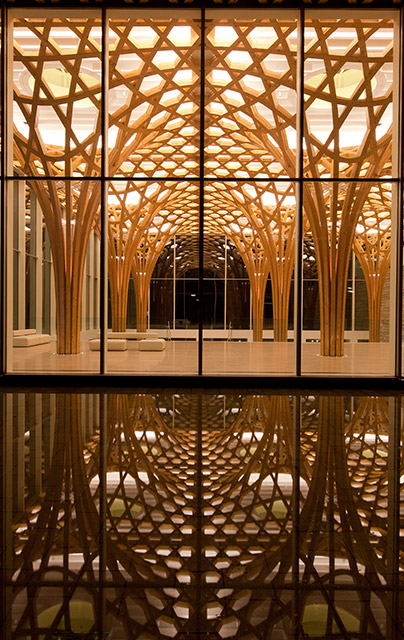
 

Haesley Nine Bridges Golf Club House, 2010, Korea

Haesley Nine Bridges Golf Club House, 2010, Korea

[pinterest]

Shigeru Ban is a tireless architect whose work exudes optimism. Where others may see insurmountable challenges, Ban sees a call to action. Where others might take a tested path, he sees the opportunity to innovate. He is a committed teacher who is not only a role model for younger generations, but also an inspiration.


Centre Pompidou-Metz, 2010, France

Centre Pompidou-Metz, 2010, France

[pinterest]

We have selected some interesting excerpts from Shigeru Ban’s interview with Hans-Ulrich Obrist in 1999.

HUO: Hassan Fathy wrote in the 1960’s on architecture for the poor. He says that for very few dollars it would be possible to grant housing to everybody all over the world, and solve the world’s housing problem. This seems to be a contemporary form of Fathy’s philosophy: housing for all. Was this social dimension of architecture always important for you, or was it triggered by some special momentum?

SB: When I came back form the United States, I was very shocked to know that in Japan, people didn’t respect architects. I thought about why: historically we didn’t have architects only 120 years ago we invited English architects to educate the people. Before, all Japanese building was built by carpenters, and none of their names remains. We don’t have a long history of architects. I thought it is the reason why architects are not respected in Japan, but that was not the real reason.

When I experienced the economic boom, many architects were just building monuments to show their ego. Architects are generally very egoistic, including me, I’d like to build my monument, too; there’s no doubt about that. But it’s not the only thing I want to do. I wanted to use my skills and knowledge for for a society. The reason I worked for Kobe and Rwanda, is, obviously, the humanitarian feeling, but also to develop my ideas further and apply them at the same time, as long as I’m satisfying the humanitarian need. The two things are mixed together.

HUO: Buildings are ephemeral…

SB: I’m always asked how long the paper structure will last. I always ask them in return how long they think wooden construction lasts. There are so many buildings in Japan which have lasted over five hundred years and more . Wood is very weak for water, even termite, but we invented beautiful joineries to replace damaged parts, so the life span of the material has nothing to do with the life span of the building, even when the material is weak, we can exchange it, so the life span of the building can go on forever. I don’t know about the durability of the life span, but it must last a very long time. But it doesn’t matter how long the paper tube lasts; if it’s damaged I can change it, so the building itself lasts forever.

HUO: So it’s actually a cliche.

SB: Yes. I think it’s interesting to show Western people the cliche. Also, this may be the traditional way of Japanese thinking. We use weak materials the way they are; I can build the papertube much stronger, even much stronger than wood, but I have no interest in making stronger materials. I’m interested in using a weak material the way it is. So that I need a weak material to create this very special space.

 

Toyo Ito Wins the Pritzker Architecture Prize 2013


Toyo Ito of Japan is the 2013 Pritzker Architecture Prize Laureate.



toyo_ito-portrait_0

Toyo Ito, the 2013 Pritzker Architecture Prize Laureate


The Pritzker Architecture Prize was established in 1979 to annually honor a living architect whose built work demonstrates a combination of those qualities of talent, vision, and commitment, which has produced consistent and significant contributions to humanity and the built environment through the art of architecture. It has often been described as “architecture’s most prestigious award” or as “the Nobel of architecture.”

toyo-ito_serpentine-gallery-01

Serpentine Gallery Pavilion, 2002, London, U.K.

 [pinterest]

Toyo Ito was born on June 1, 1941 in Keijo (Seoul), Korea (Japanese). His father was a business man with a special interest in the early ceramic ware of the Yi Dynasty of Korea and Japanese style paintings. In 1943, Ito, his mother, and his two elder sisters moved back to Japan. Two years later, his father returned to Japan as well, and they all lived in his father’s hometown of Shimosuwa-machi in Nagano Prefecture. His father died in 1953, when he was 12. After that the rest of family operated a miso (bean paste) making factory. At present, all but one sister who is three years older than Ito, have died.

Ito established his own architecture office in 1971, and the following year he married. His wife died in 2010.

toyo-ito_sendai-mediatheque-03

Sendai Mediatheque, 1995—2000, Sendai-shi, Miyagi, Japan
Photo by Tomio Ohashi


[pinterest]

Toyo Ito calls the Sendai Mediatheque, completed in 2001 in Sendai City, Miyagi, Japan, one of the high points of his career. In the Phaidon book, Toyo Ito, he explains, “The Mediatheque differs from conventional public buildings in many ways. While the building principally functions as a library and art gallery, the administration has actively worked to relax divisions between diverse programs, removing fixed barriers between various media to progressively evoke an image of how cultural facilities should be from now on. This openness is the direct result of its simple structure, consisting of flat concrete slabs (which are honey-comb steel plates with concrete) penetrated by 13 tubes. Walls on each floor are kept to an absolute minimum, allowing the various functions to be freely distributed throughout the open areas between the tubes.“


toyo-ito_za-koenji-theatre-01

Za-Koenji Public Theatre, 2005—2008, Suginami-ku, Tokyo, Japan

[pinterest]

Toyo Ito has received numerous international awards, including in 2010, the 22nd Praemium Imperiale in Honor of Prince Takamatsu; and in 2006, The Royal Institute of British Architects’ Royal Gold Medal; and in 2002, the Golden Lion for Lifetime Achievement for 8th Venice Biennale International Exhibition.


Calling him a “creator of timeless buildings,” the Pritzker Jury cites Ito for “infusing his designs with a spiritual dimension and for the poetics that transcend all his works.


toyo-ito_funeral-hall-01

Meiso no Mori Municipal Funeral Hall, 2004—2006, Kakamigahara-shi, Gifu, Japan


[pinterest]

Toyo Ito made this comment in reaction to winning the prize:

“Architecture is bound by various social constraints. I have been designing architecture bearing in mind that it would be possible to realize more comfortable spaces if we are freed from all the restrictions even for a little bit. However, when one building is completed, I become painfully aware of my own inadequacy, and it turns into energy to challenge the next project. Probably this process must keep repeating itself in the future. Therefore, I will never fix my architectural style and never be satisfied with my works,” he concluded

toyo-ito_matsumoto-arts-04

Matsumoto Performing Arts Centre, 2000—2004, Matsumoto-shi, Nagano, Japan
Photo by Hiroshi Ueda


[pinterest]

Ito has said that he strives for architecture that is fluid and not confined by what he considers to be the limitations of modern architecture.

When interviewed by Liddell in 2007 Ito commented “That process from creation to realization is very difficult to explain, because, generally speaking, when I imagine something, there’s no gravity and there’s nothing restricting imagination, but when we embark on the process of realization, we have to enter the real world.”

toyo-ito_museum-of-art-01

Toyo Ito Museum of Architecture, 2006—2011, Imabari-shi, Ehime, Japan
Photo by Daici Ano


[pinterest]

Toyo Ito museum of Architecture opened in 2011 and showcases his past projects as well as serving as a workshop for young architects.


“Firmness, Commodity and Delight”


If you want to learn more about the Pritzker Architecture Prize check out the beautiful infographic created by Innovus. Click in the image below to see full infographic.

 2013_infoGraphic_thumb

 Infographic by @Innovusdecors

« Older posts Newer posts »