design + energy + excellence

Tag: Environment (Page 1 of 2)

Renewable Energy Research Trip to Austria

Last November I went on a research trip to Austria. The trip included a number of visits to factories from the Renewable Energy Sector and also to buildings with Passive House characteristics.

Austria is one of the world’s leaders in renewable energy and sustainability. And I was very well impressed with all the places we visited and the way Austria is developing their sustainability strategy.

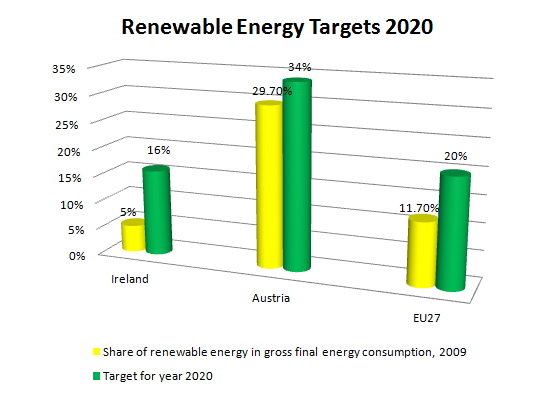
Electricity generated by Renewable resources, comparison Ireland Austria, percentage of renewable energy in Ireland and Austria

Source: Eurostat

Austria generates 67% of its electricity from renewable sources. Ireland with its 14% is still a long way to go to catch this performance. That is why we can learn so much from the Austrian model.

The research trip included the visit to the following:

  1. Power Tower (Passive House building)
  2. SOLution Solartechnik (solar panels)
  3. Fronius (solar inverters, battery charging systems)
  4. Guntamatic (biomass boilers)
  5. Neura (heat pumps)
  6. Biomass Research Centre Bioenergy 2020+
  7. Billa supermarket (Green Building Award)
  8. Smart City Project Klosterneuburg
  9. Energy Base (Passive house offices)

During 2012 I will try to post more details and photos of this trip. Watch this space!

Energy will continue to be a priority for the European Commission going forward and we all need to work together in order to be more energy efficient. Ireland has been progressing quite well and its capacity to deliver renewable electricity has continued to grow by an average of more than 150 MW per year.

The target for Ireland in the European Renewable Energy Directive (2009/28/EC) is a 16% share of renewable energy in gross final consumption by 2020. New and more strict regulations have been introduced in order to meet this target.

To learn more about Energy in Ireland click here to download the 2011 Report “Energy in Ireland 1990 – 2010” published by SEAI.


Isabel Barros
Minimum Requirements of Energy to be Provided by Renewable Energy Technologies


In Ireland, Building Regulations set out the legal requirements for the design and construction of buildings.


Part L of the Building Regulations lays out the requirements regarding conservation of fuel and energy for dwellings.


The following represents the minimum requirements of energy to be provided by renewable energy technologies in new dwellings:

  • 10 kWh/m2/annum contributing to energy use for domestic hot water heating, space heating or cooling, or
  • 4 kWh/m2/annum of electrical energy, or
  • a combination of these which would have equivalent effect.


Understanding Renewable Energy – FAQ’s

————————–


Join our Facebook Group here.

View Isabel Barros's LinkedIn profileView Isabel Barros’s profile

 

A Space for Learning in New Ross

I have been working with the Transition Year students of Our Lady of Lourdes School in New Ross, Wexford, to develop an idea for a new space for learning in their school.

“A Space for Learning” is a design ideas competition initiated by the Irish Architecture Foundation to challenge current thinking on school design and architecture.

The starting point for this project was a discussion of basic Architectural concepts. The students had the opportunity to identify a number of different concepts from architectural books and magazines.

Final Submission - Panel 1

Environmentally sustainable design

Sustainability was an integral part of the design process. A number of passive solar design concepts were approached and the proposal aims to get the most from direct, indirect and isolated solar gains, as well as natural lighting and natural ventilation.

Natural lighting is reflected into the classrooms by the use of light shelves, thus reducing the need for electricity.

The green roof provides increased insulation and works as a thermal mass.

The greenhouses, below the South facing classrooms, capture solar radiation that is converted into heat. This heat is directed into the classrooms through vents that can be closed during Summer time.

Rain water is captured, stored and re-used for toilet flushing and watering within the gardens and greenhouses.

A recycling point comprising of four Moloks ® will support the sustainability strategy while maintaining an attractive and hygienic environment.

Final Submission - Panel 2

Systems

The proposal aims to contribute to a reduced carbon footprint. To achieve this goal, different systems are proposed:

 -two vertical wind turbines producing approx. 20,000kwh/year;

 -twenty-three photovoltaic solar panels to convert sunlight into electricity

 -a geothermal vertical system to power the underfloor heating.

An automated system provides a single point of control for lighting, heating, and cooling, for maximum efficiency. Each classroom operates independently, according to its designated schedule, so energy is not wasted in rooms that are not in use.

Exhibition

Between 5 and 10 selected groups will develop their design idea into an exhibition. Proposed ideas for the exhibition format had to be included in the submission.

Our final exhibition piece will allow visitors to experience the new building via a virtual world platform.

Visitors will be able to access the virtual model of our proposed building using a computer. They will be able to create their own avatar and tour around the proposed building. The software allows the same virtual world to be accessed by multiple visitors if more than one computer is available at the exhibition. It is also possible to continue this experience from the comfort of the visitor’s home, via the Internet.

————————–

Visit the Facebook Page for this project: http://www.facebook.com/SpaceForLearningInNewRoss

View Isabel Barros's LinkedIn profileView Isabel Barros’s profile

« Older posts