Wang Shu of The People’s Republic of China is the 2012 Pritzker Architecture Prize Laureate.

Wang Shu, the 2012 Pritzker Architecture Prize Laureate
The international prize, which is awarded each year to a living architect for significant achievement, was established by the Pritzker family of Chicago through their Hyatt Foundation in 1979. Often referred to as “architecture’s Nobel” and “the profession’s highest honor,” it is granted annually.

Five Scattered Houses, Ningbo, China. Photo by Lang Shuilong.
[pinterest]
Wang Shu has often explained in lectures and interviews that “to me architecture is spontaneous for the simple reason that architecture is a matter of everyday life. When I say that I build a ‘house’ instead of a ‘building’, I am thinking of something that is closer to life, everyday life. When I named my studio ‘Amateur Architecture’, it was to emphasize the spontaneous and experimental aspects of my work, as opposed to being ‘official and monumental’.”

Xiangshan Campus, China Academy of Art, Hangzhou, China. Photo by Lv Hengzhong
[pinterest]
As a child Wang Shu moved around a lot with his parents living in houses as small as 15 sq.m.
When living in Xi’an, 1,000km west of Beijing, his family didn’t have a television. They use to sat on one bed chatting in the evening, which gave him a happy and interesting experience, he says.
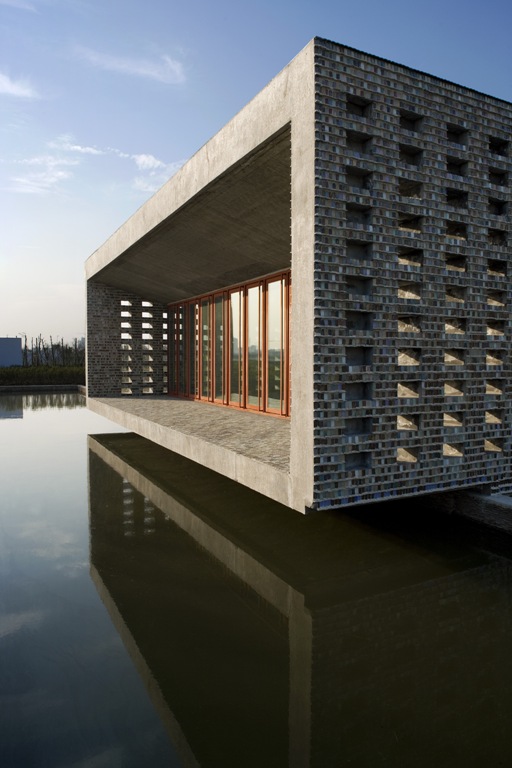
Ceramic House, 2003-2006, Jinhua, China. Photo by Lv Hengzhong
[pinterest]
Wang Shu felt the Tangshan earthquake in Xi’an in 1976. His family had to move to a bamboo shed where hundreds of families lived together. Each family was given an area the size of a double bed and they lived there for three months until they built a house with only 15 sq metre and one room!

Ningbo History Museum, Ningbo, China. Photo by Lv Hengzhong
[pinterest]
His philosophy of paying scrupulous attention to the environment suggests that buildings located between water and mountains should not be prominent.

Ningbo History Museum, Ningbo, China. Photo by Lv Hengzhong.
[pinterest]
True to his methods of economy of materials, he salvaged over two million tiles from demolished traditional houses to cover the roofs of the campus buildings.
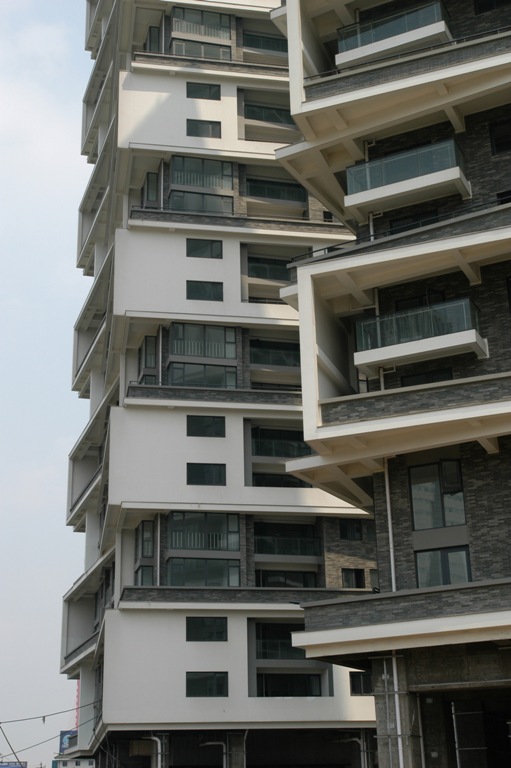
Vertical Courtyard Apartments, Hangzhou, China. Photo by Lu Wenyu.
[pinterest]
Wang Shu is attracted by the variety of buildings just like the different lifestyles people have.He is certainly a gifted dreamer with an amazing life experience.
If you want to learn more about the Pritzker Architecture Prize check out the beautiful infographic created by Innovus. Click in the image below to see full infographic.

Infographic by