design + energy + excellence

Category: General (Page 20 of 28)

Home Renovation Incentive Scheme

The Home Renovation Tax Incentive (HRI) scheme was announced in the Budget 2014  and will run from 25 October 2013 to 31 December 2015.

This incentive provides a tax relief by way of an income tax credit at 13.5% of qualifying expenditure on:

• repair

• renovation or

• improvement works.

This includes extensions, garages and attic conversions; the supply and fitting of kitchens, bathrooms and built-in wardrobes; fitting of windows; plumbing, tiling, rewiring and plastering.

To qualify for the HRI, you must be an owner-occupier and the work must be carried out on your principal private residence.

Any contractor you use must be registered for Value Added Tax (VAT) in Ireland and be tax-compliant. If several contractors, such as a builder, a plumber and an electrician, carry out qualifying work on your home, you can combine the cost of the works to make up the minimum qualifying amount.

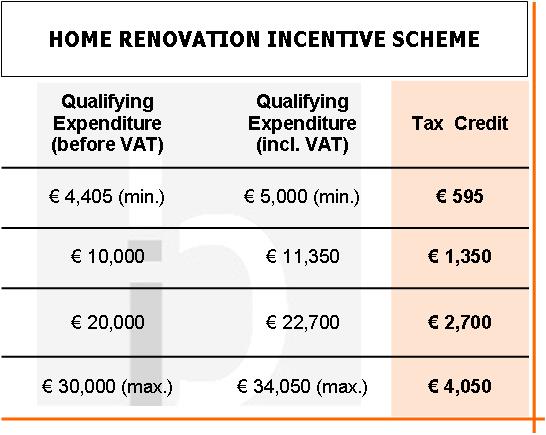
Have a look at the table below to see some examples of the tax credit you can get.

HRI TableThe works must cost a minimum of €4,405 (before VAT), which will attract a credit of €595. Where the cost of the works exceeds €30,000 (before VAT), a maximum credit of €4,050 will apply.


 

Example 1

luxury-bathrooms.1153.featured

You hired a builder to carry out a bathroom renovation for €10,000 (before VAT at 13.5%). The work was carried out and paid for in April 2014. Your builder entered the details to the electronic HRI system.

You hired a painter to carry out internal and external painting for €2,000 (before VAT at 13.5%). The work was carried out and paid for in September 2014. Your painter entered the details to the electronic HRI system.

You claim your tax credit in January 2015. Your tax credit is €12,000 x 13.5% = €1,620. You receive your tax credit of €810 in 2015 and €810 in 2016.


Example 2

You paid €7,048 plus VAT (at 13.5%) of €952 = €8,000 for repair works and an insurance payment of €6,000 was received in respect of the repair works.

The qualifying expenditure of €8,000 will be reduced by €6,000.

Leaving €2,000 (€8,000 less €6,000) qualifying expenditure.

This €2,000 includes VAT of €238.

The tax credit can be claimed on the €2,000 less €238 = €1,762 (before VAT).


Example 3

€8,810 plus VAT (at 13.5%) of €1,190 = €10,000 was paid for external wall insulation.

€2,700 was received under the Better Energy Home scheme grant.

The €10,000 will be reduced by €8,100 (€2,700 x 3) leaving €1,900 (€10,000 less €8,100) qualifying expenditure.

This €1,900 includes VAT of €226.

The tax credit can be claimed on the €1,900 less €226 = €1,674 (before VAT).


Example 4

 Electrician

You paid €5,000 (before VAT) to a VAT registered and tax compliant electrician for rewiring your home, your tax credit is €5,000 x 13.5% = €675.


Example 5

You paid a VAT registered and tax compliant builder €40,000 (before VAT) for an extension on their home

The tax credit is €30,000 x 13.5% = €4,050.


Examples of repair, renovation or improvement works that qualify under the Incentive:

  • Painting and decorating
  • Rewiring
  • Tiling
  • Supply and fitting of kitchens
  • Extensions
  • Garages
  • Landscaping
  • Supply and fitting of solar panels
  • Conservatories
  • Plastering
  • Plumbing
  • Bathroom upgrades
  • Supply and fitting of windows
  • Attic conversions
  • Driveways
  • Septic tank repair or replacement
  • Central heating system repair or upgrade
  • Supply and fitting of built in wardrobes

The VAT rate on works carried out must be 13.5%.

Please note the above is not a complete list.


What type of home qualifies?

A qualifying home is:

  • A Homeowners main home, which the Homeowner must own and live in or
  • A second hand home, which the Homeowner has bought and will live in as the Homeowner’s main home after the works have been carried out. (A complete reconstruction of an uninhabitable house does not qualify).


Please check the Revenue website for more information.

Why Should Clients Care?


In Ireland the Royal Institute of the Architects of Ireland -RIAI requires to its members a minimum of 40 hours of CPD activity in the course of each year.

CPD, or Continuing Professional Development, is the term used to describe lifelong learning or continuing education as it relates to those active in the professions. There have been several attempts to define the concept, but this one has wide application:

The systematic maintenance, improvement and broadening of knowledge and skill and the development of personal qualities necessary for the execution of professional and technical duties throughout the practitioner’s working life‘.


2013_10_14_CPD


What exactly do RIAI Architects need to do?

The RIAI requires the following minimum level of CPD involvement.

1) In the course of each year, each registrant/member must accumulate a total of 40 hours of CPD activity, divided as follows:

a. 20 hours Structured CPD

b. 20 hours Unstructured CPD


Professionals have a duty to ensure that they are capable of providing the services they offer. Within the context of RIAI CPD Requirements it is the responsibility of each registrant/member to judge the best approach to undertaking the CPD activity necessary to;

a. maintain compliance with the relevant Standard of Knowledge, Skill and Competence , and

b. acquire and maintain the skills appropriate to their current activities and chosen career path.


What happens if a RIAI Architect cannot fulfill his/hers CPD obligation?

A registrant/member whose CPD record is “Incomplete” at the end of the CPD cycle will be asked to provide an explanation for non-compliance. Unless there is good reason the matter will be referred to the Professional Conduct Committee. Sanctions open to the Processional Conduct Committee include censure, fines, suspension, conditions for continued registration, and removal from the register.


Why should clients care?

When you are hiring a RIAI Architect you are hiring a professional that must take all reasonable steps to maintain an appropriate level of professional skills on an ongoing basis. CPD is the process of regularly assessing current and future skill and knowledge requirements relevant to the Architect’s responsibilities.

Recently, we were disappointed with the fact that a particular professional (not a RIAI member) was not familiar with a recent (very important) change in the Irish regulations. We do not think a RIAI member would lack this important information and we, RIAI members, certainly have to thank the Institute for supporting us and promoting the performance and the reputation of the profession. RIAI has developed one of the most demanding CPD requirements we know and this can only mean that high standards are at the forefront of their policies.

We just wish a similar system would be implemented for builders and tradespeople! It protects the consumer and the public interest, and increases effectiveness of construction practices.

My CPD Summary - 2013-10-14_17.46.21

CPD Summary Isabel Barros 1 Oct 2011 – 30 Sept 2012


The Secret Guide to Deal with Architects – Take 4


This is our 4th secret tip about how to deal with an Architect.

If you have just landed here do not miss our previous tips:

This time we give you some tips about ‘Your Budget’. Your budget may be restricted by the personal savings you have or by the bank loan or mortgage you can get, or by a mixture of both.


4. Your Budget

Be realistic about the cost to build your project!

The current economic climate may lead you to think everything is cheap or even free. That is not correct and if you look at our latest article about Construction Costs you will realise that prices are actually increasing.

And if that was not enough, increased responsibilities required from designers, builders and clients due to new regulations are also rising the construction costs.


Take 4


Hot tip: Ask your Architect for an average construction price per square metre. Multiply that figure by the area you will need for your project (you can also ask your Architect for an approximate area needed to accommodate your Brief), add between 5% and 10% for contingencies and add costs for renewable energy systems. Also be aware of the typical exclusions of the Irish Construction Costs (read last section of our article Construction Costs in Ireland 2013).


Go to Take 5 – Be Honest.


Start from Take 1 – Stages.


« Older posts Newer posts »