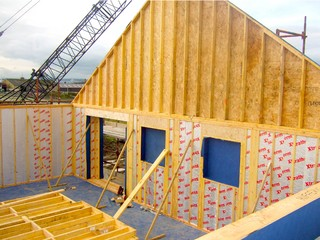
Advantages of Timber Frame Construction
- Recyclable
- Renewable
Timber is classified as a renewable material, as the principle holds that if a tree is felled another is planted in its place. As long as this balance is maintained, the supply will be sustainable.
- Low embodied energy if constructed in local timber
- Reduced construction waste through efficient controlled manufacturing
- Low volume of waste on site requiring removal
- Quick build time
A prefabricated timber frame can be erected on site faster than a comparable brick and block construction. However, timber frames may require additional time for their design and fabrication, which can lead to a longer wait before work begins on site. 
- Reduced site labour
- Reduced time to weather the structure
- Earlier introduction of following trades
The quicker erection time enables interior trades such as plastering and electrical wiring to begin work earlier in the build programme, as the interior will be exposed to weather for less time.
- Can be built to exceed 60-year design life
- Energy efficient when constructed to current standards
- Fast heating due to low thermal mass
Their low thermal mass allows spaces enclosed by timber frames to heat up more quickly than masonry construction, however they will also tend to cool more quickly.
- Reduced time on site reduces environmental nuisance and disruption to local residents
- Engineered product
- Factory controlled quality assurance in fabrication
Off site fabrication can allow higher quality to be achieved.
- Efficient use of material due to controlled engineering and fabrication
- Reduced construction time translates into reduced risk exposure
Potential Problems with Timber Frame Construction
- Traditional procurement process
- Additional design and engineering time
- Modification of general arrangement drawings if based on masonry construction
- Lack of experienced builders and erection crews
- Lack of experience of following trades
- Transportation and carriage access
- Exposure to weather before enclosed
- Work of following trades
- Deficiency of site quality control
- Combustibility of timber requires vigilant quality control to achieve required fire rating of separating and compartment walls
The fire resistance of timber frame buildings is achieved by a combination of the lining material, the timber structure and the insulation.
Additional fire protection can be given to the frame by the boarding used to clad it and fire stops installed to prevent spread through the cavity.
Recent fire tests commissioned by the Timber Frame Industry and the ITFMA showed that in general a 15mm Type A plasterboard is required to meet the Fire resistance of REI 30 for external walls (see detail).
The risk of fire can be increased if timber frames are not erected correctly, and during construction prior to fire protection being installed.
- Susceptibility to decay of timber when exposed to excessive moisture
Timber frame structures must include a vapour barrier between the lining of the inner wall and the insulation, to prevent vapour passing through.
- Acoustics
Timber frame structures may not achieve the same level of sound insulation as concrete or masonry as they are not as dense.

Timber Frame – Wall Detail (Service Cavity Wall)