Shigeru Ban, a Tokyo-born, 56-year-old architect is the 2014 Pritzker Architecture Prize Laureate.
Reached at his Paris office, Shigeru Ban said, “Receiving this prize is a great honor, and with it, I must be careful. I must continue to listen to the people I work for, in my private residential commissions and in my disaster relief work. I see this prize as encouragement for me to keep doing what I am doing — not to change what I am doing, but to grow.“

Shigeru Ban, the 2014 Pritzker Architecture Prize Laureate
Shigeru started his practice without any working experience right after he graduated from Cooper Union (New York). He is well known for making monumentality out of cardboard.
Shigeru has used cardboard tubes to build a number of structures. He hates to thrown things away, and in 1985 when he was left with lots of cardboard tubes from an exhibition he designed for Emilio Ambasz, he decided to re-use them for an exhibition for Alvar Aalto. This was the first time he began experimenting with spatial applications for cardboard tubes.

Alvar Aalto Exhibition,1986, Tokyo
[pinterest]
Ban’s humanitarian work began in response to the 1994 conflict in Rwanda, which threw millions of people into tragic living conditions. Ban proposed paper-tube shelters to the United Nations High Commissioner for Refugees and they hired him as a consultant.

Paper Log House, 1995, Kobe, Japan
[pinterest]
Shigeru Ban reflects the spirit of the prize to the fullest. He is an outstanding architect who, for twenty years, has been responding with creativity and high quality design to extreme situations caused by devastating natural disasters. His buildings provide shelter, community centers, and spiritual places for those who have suffered tremendous loss and destruction. When tragedy strikes, he is often there from the beginning, as in Rwanda, Turkey, India, China, Italy, and Haiti, and his home country of Japan, among others.

Paper Temporary Studio, 2004, Paris, France
[pinterest]
His own studio, a top terrace at the Pompidou Center in Paris for the six years he was working on the museum project for Metz, was built using cardboard tubes and a membrane covering the arched roof.

Cardboard Cathedral, 2013, Christchurch, New Zealand
[pinterest]
In an interview with Hans-Ulrich Obrist in 1999 Shigeru Ban said “this material is much stronger than I expected. People have the preconceived idea that paper is very weak, but paper is an industrial material: we can make it fire retardant or waterproof, and we can make it as strong as wood. I started testing the strength of paper tube and found it was strong enough to make a building structrure.”

Japan Pavilion, Expo 2000 Hannover, 2000, Germany
[pinterest]
For Shigeru Ban, sustainability is not a concept to add on after the fact; rather, it is intrinsic to architecture. His works strive for appropriate products and systems that are in concert with the environment and the specific context, using renewable and locally produced materials, whenever possible.
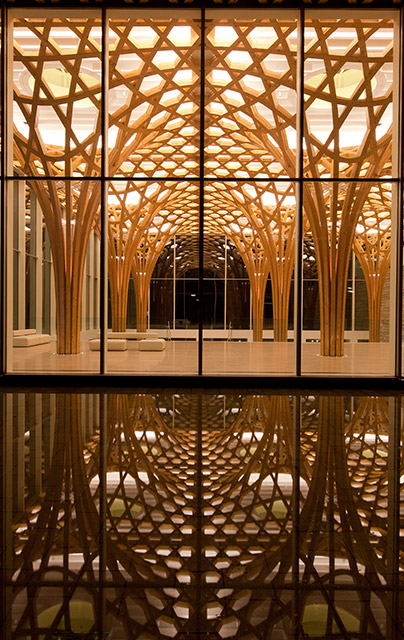
Haesley Nine Bridges Golf Club House, 2010, Korea
[pinterest]
Shigeru Ban is a tireless architect whose work exudes optimism. Where others may see insurmountable challenges, Ban sees a call to action. Where others might take a tested path, he sees the opportunity to innovate. He is a committed teacher who is not only a role model for younger generations, but also an inspiration.

Centre Pompidou-Metz, 2010, France
[pinterest]
We have selected some interesting excerpts from Shigeru Ban’s interview with Hans-Ulrich Obrist in 1999.
HUO: Hassan Fathy wrote in the 1960’s on architecture for the poor. He says that for very few dollars it would be possible to grant housing to everybody all over the world, and solve the world’s housing problem. This seems to be a contemporary form of Fathy’s philosophy: housing for all. Was this social dimension of architecture always important for you, or was it triggered by some special momentum?
SB: When I came back form the United States, I was very shocked to know that in Japan, people didn’t respect architects. I thought about why: historically we didn’t have architects only 120 years ago we invited English architects to educate the people. Before, all Japanese building was built by carpenters, and none of their names remains. We don’t have a long history of architects. I thought it is the reason why architects are not respected in Japan, but that was not the real reason.
When I experienced the economic boom, many architects were just building monuments to show their ego. Architects are generally very egoistic, including me, I’d like to build my monument, too; there’s no doubt about that. But it’s not the only thing I want to do. I wanted to use my skills and knowledge for for a society. The reason I worked for Kobe and Rwanda, is, obviously, the humanitarian feeling, but also to develop my ideas further and apply them at the same time, as long as I’m satisfying the humanitarian need. The two things are mixed together.
HUO: Buildings are ephemeral…
SB: I’m always asked how long the paper structure will last. I always ask them in return how long they think wooden construction lasts. There are so many buildings in Japan which have lasted over five hundred years and more . Wood is very weak for water, even termite, but we invented beautiful joineries to replace damaged parts, so the life span of the material has nothing to do with the life span of the building, even when the material is weak, we can exchange it, so the life span of the building can go on forever. I don’t know about the durability of the life span, but it must last a very long time. But it doesn’t matter how long the paper tube lasts; if it’s damaged I can change it, so the building itself lasts forever.
HUO: So it’s actually a cliche.
SB: Yes. I think it’s interesting to show Western people the cliche. Also, this may be the traditional way of Japanese thinking. We use weak materials the way they are; I can build the papertube much stronger, even much stronger than wood, but I have no interest in making stronger materials. I’m interested in using a weak material the way it is. So that I need a weak material to create this very special space.